INDUSTRIALIZED CONSTRUCTION
The same panels have poured this villa, and the one before it, and the one before that.
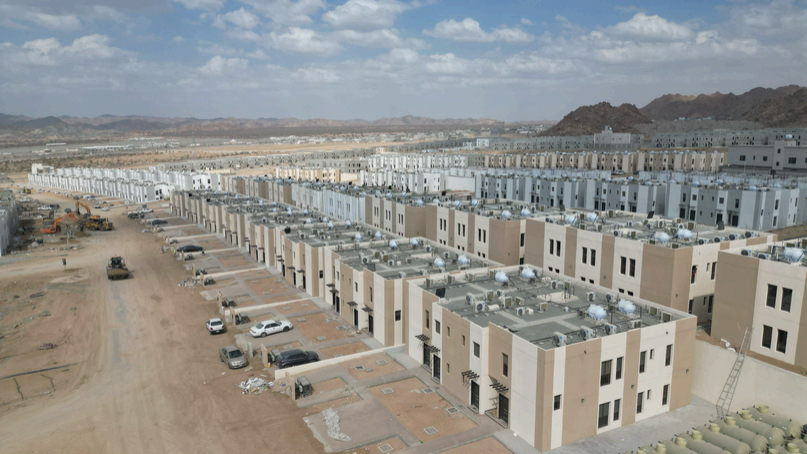
Twenty-four sets of precision aluminum formwork move through Al Fursan. Each set is bolted up, poured, stripped the next day, and carried to the next plot. The panels are rated for more than a thousand pours, confirmed in writing, so one set can produce more than 250 villas before it retires.
Nothing is consumed. The tooling travels and the buildings stay. That is the whole idea.
FROM SEQUENTIAL TRADES TO A REPEATABLE CYCLE
Conventional structure is five trades waiting for each other. This is one.
Ordinarily a structure advances through columns, then beams, then slabs, then blockwork, then plaster, each with its own crew, its own setup, its own handoff and its own opportunity to be late.
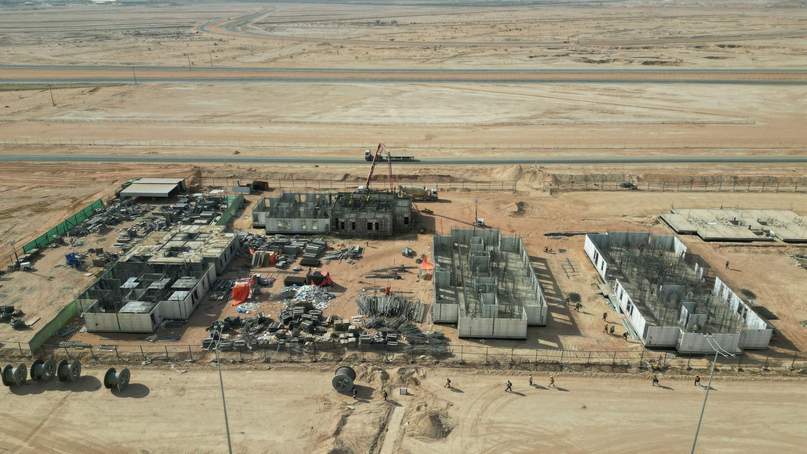
We pour reinforced concrete walls and slabs together, as one monolithic structure, in a single cycle. Then the panels are stripped, moved and used again.
The commercial benefit is all in the repetition:
- Five structural handoffs become one
- Progress becomes a daily count instead of a monthly percentage
- Dimensions and surface quality stop varying between units
- The formwork is an asset with a rated life, not a cost consumed by the job
- The process is stable enough to be measured, predicted and improved
THE SCHEDULE BECOMES A PRODUCTION TARGET
"Are we on schedule?" is a bad question. "Did the line produce today?" is a good one.
The first question can be answered with an opinion, and usually is, right up until month nine.
The second has one answer, it arrives every evening, and it is either yes or no. Then the only remaining question is what would stop tomorrow's, which is a question a site manager can actually act on.
Each line is configured around your geometry, your available panels, your crew capacity and your date. For high-volume repeated housing, that configuration typically lands between three and six core-and-shell units per working day. Al Fursan runs at three.
Production timing is measured from notice to proceed. The rate depends on the agreed design, scope, site readiness and panel count, and we will show you that calculation before you commit to it.
ONE CONTINUOUS STRUCTURAL SYSTEM
Why monolithic matters, in one paragraph
Walls and slabs poured together behave as one connected structure rather than as parts fastened to each other. That gives you structural continuity, repeatable geometry across units, and formed surfaces smooth enough that the finishing systems can run straight onto them without a plastering trade in between.
It also removes a long sequence of separate structural and blockwork activities, which is where a surprising amount of a housing program's time actually goes.
STANDARDIZE THE PRODUCTION LOGIC, NOT THE CUSTOMER'S CHOICE
The objective is not identical buildings. It is dependable production.
A shared library of reusable panels supports varied layouts and architectural expression. At Al Fursan the same fleet builds four villa types, in end and mid variants, across a row.
Where standard components genuinely do not fit, custom panels are engineered for the geometry. That is currently bought in. From 2027 it is what STRUX will make.
TAKT checks each design decision against the panels actually available, the crew time it is predicted to cost, and the production target, before anyone commits to fabricating anything.
A PRODUCTION LINE THAT CAN SEE AHEAD
Every cycle becomes evidence for the next one.
TAKT follows each structural cycle and forecasts closure and pour readiness, cycle duration, emerging constraints, material and equipment timing, drift from the target rate, and the single next action most likely to protect output.
Then the pour happens, and the forecast is scored against it. About 4,300 times across this program.
Closing