Standard production
Repeatable components at consistent, high-volume output. This is the majority of any housing program and it should be treated like stamping, not like joinery.
STRUX MANUFACTURING · BEING BUILT FOR 2027
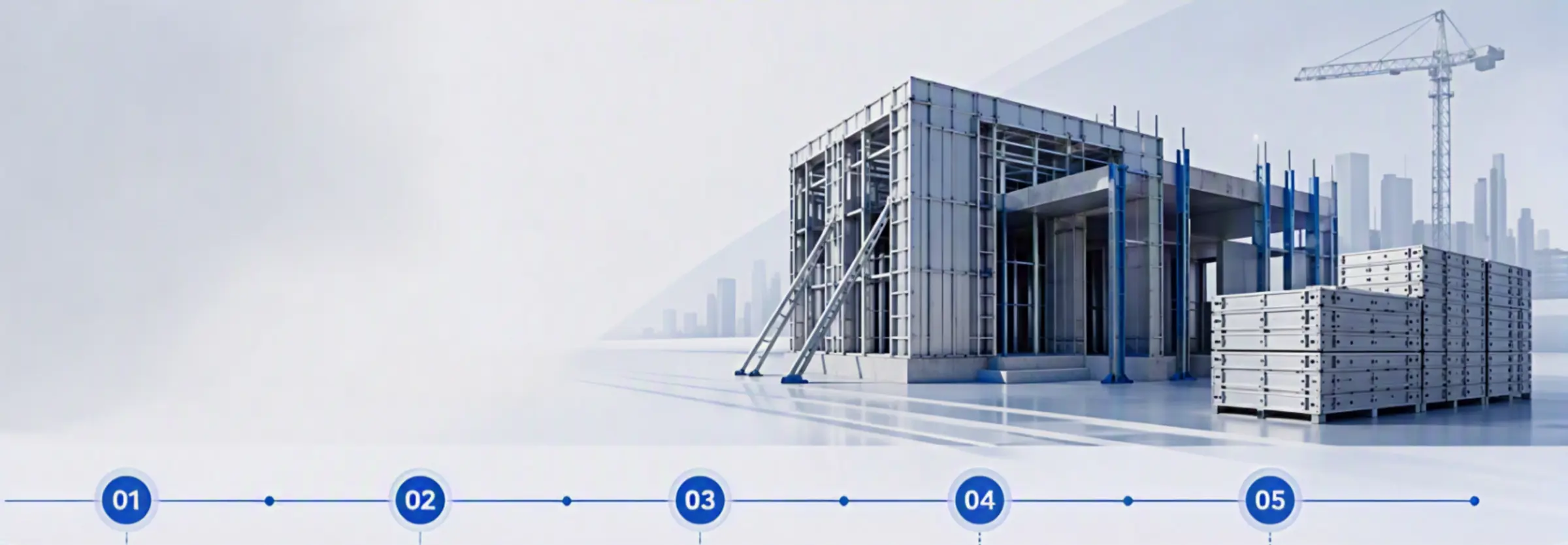
Formwork is not a material. It is the machine that builds the building, and it is the physical ceiling on how much TBS can produce in a year.
Every new production line needs another set of panels. Every set costs about SAR 1,884 per square meter, is paid for before it is made, and takes roughly three months to reach site. A villa at Al Fursan takes between 1,800 and 2,200 square meters of contact area, which is why the fleet there runs to 13,271 square meters across 24 sets.
We already run the factory. We do not yet own the machine that feeds it. STRUX is that machine.
WHY THIS IS THE CONSTRAINT
Consider the position it puts a growing construction company in. To bid a program you need panels. To have panels you must order them a quarter early and pay for them then. So you are either buying capacity for work you have not won, or you are turning down work because your panels are on another site.
Neither is a business. Both are a tax on growth, paid in cash, up front, to a supplier on another continent.
Owning the plant changes four things at once: the lead time collapses from months to weeks, the cash stops leaving the country before the contract starts, custom geometry stops being a premium and becomes a Tuesday, and panel repair and refurbishment happen in-house instead of by container ship.
STANDARD SPEED. CUSTOM FLEXIBILITY.
High-volume construction needs standardization. Real buildings rarely come out of one catalog. The 2027 STRUX operating model runs two production logics side by side.
Repeatable components at consistent, high-volume output. This is the majority of any housing program and it should be treated like stamping, not like joinery.
Nonstandard panels and project-specific geometry, engineered rather than improvised. Today this is the expensive, slow part, because it is ordered from abroad like everything else.
ENGINEER · MANUFACTURE · DELIVER · INSTALL · SUPPORT
The 2027 model covers engineering, manufacturing, quality assurance, delivery, installation and support under one accountable workflow.
Approved drawings become a production-ready panel plan, standard and custom together.
Aluminum components cut, formed and finished under controlled process conditions.
Dimensions and manufacturing quality verified before a set leaves for site, because a panel that does not fit stops a pour, and a stopped pour costs a villa.
Logistics sequenced against the installation and pour schedule rather than against a shipping calendar.
Deployment, maintenance and refurbishment, so a fleet keeps earning across its rated life instead of quietly degrading.
THE SYSTEM MUST KEEP WORKING AFTER DELIVERY
Aluminum formwork is a productive asset. Its value is the number of good pours it produces before it retires, and that number is decided by fit, condition, maintenance and how carefully it is handled by people under time pressure.
Which is why every panel at Al Fursan carries a QR code and is scanned in and out of each villa. We know where about ten thousand panels are, how many pours each has done, and which ones are approaching the point where they need attention rather than another cycle.
Delivery is the start of the relationship, not the end of the transaction.
THE PHYSICAL SYSTEM MEETS THE PRODUCTION TWIN
TAKT connects design decisions to the panels that exist, the cycle time they are predicted to produce, and what the line actually did last week. Before anything is fabricated, that answers:
STRUX will make the physical system. TAKT decides how it should be used. Neither is worth as much without the other, which is the reason both are being built by the same company.
Closing